Krishna–Arjuna relationship
Bhagavad GitaKrishna–Arjuna relationship is the decisive human and theological bond in the dialogue. On the battlefield of Kurukshetra, Krishna stands beside Arjuna not merely as a companion but as his charioteer, guide, teacher, and object of devotion. Their relationship carries the movement from intimate trust through moral crisis to spiritual recognition: Arjuna begins unable to act, while Krishna answers his collapse by redefining action, duty, knowledge, sacrifice, and liberation.
Identity and Foundation
The relationship is established amid the armies assembled for battle. Krishna and Arjuna occupy the same great chariot, drawn by white steeds, and sound their celestial conches before the fighting begins. Krishna blows Panchajanya, while Arjuna blows Devadatta; the paired act places them together at the threshold of war and distinguishes their partnership from the opposing military formations. The scene is public and martial, yet the decisive action soon becomes conversational rather than violent.
Arjuna’s first request to Krishna reveals both trust and dependence. He asks Krishna to place the chariot between the two armies so that he can inspect those with whom he must contend and understand whom he is being called upon to fight. Krishna complies, positioning the chariot before Bhishma, Drona, and the assembled kings. In this gesture, Krishna accepts the practical role of driver while also creating the vantage from which Arjuna’s crisis will become visible.
Crisis and Moral Conflict
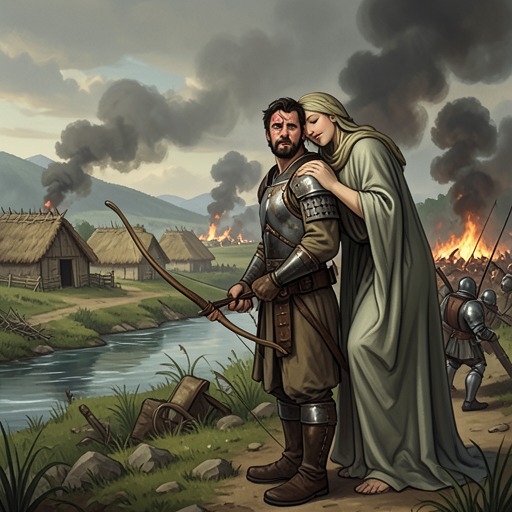
From the chariot, Arjuna sees fathers, sons, grandfathers, teachers, in-laws, friends, and other kinsmen standing in both armies. His response is physical as well as intellectual: his limbs weaken, his mouth dries, his body trembles, his hair stands on end, and Gandiva slips from his hand. The bond with Krishna gives this collapse a direct recipient. Arjuna does not conceal his fear or disguise it as certainty; he turns to Krishna and explains why victory, sovereignty, pleasure, and even life seem worthless if they require the deaths of those for whose sake such rewards are desired.
Arjuna’s argument is rooted in kinship, reverence, and the preservation of social order. He is especially troubled by the prospect of killing Bhishma and Drona, whom he regards as worthy of worship. He reasons that victory over his teachers would produce bloodstained pleasures, while defeat at their hands might be preferable to becoming their killer. He also fears that destroying a family will extinguish its customs and rites, produce social disorder, and bring sin upon both the destroyers and the destroyed community. The relationship therefore begins its most important phase as a conflict between Arjuna’s immediate loyalty to persons and the larger obligation Krishna will ask him to recognize.
Arjuna finally converts friendship into discipleship. He says that compassion has unsettled his nature and that he no longer knows what his duty requires; he asks Krishna to tell him what is certainly good and explicitly declares himself Krishna’s disciple. After stating that he will not fight, Arjuna falls silent. Krishna’s authority does not erase their intimacy, but it changes the terms of their exchange: the companion who drives the chariot becomes the instructor whose words must address a crisis of conscience.
Krishna as Teacher and Guide
Krishna’s response begins by challenging Arjuna’s despondency as unworthy at such a moment and urging him to rise. He then develops a sustained teaching in which action and renunciation are no longer simple opposites. Krishna explains that no one can remain without action even for a moment, and that mere withdrawal from work does not by itself bring freedom. Arjuna is therefore taught to act without attachment, performing work as an offering rather than pursuing its fruits. This teaching directly answers the apparent contradiction Arjuna sees between spiritual devotion and dreadful action.
The relationship also expands beyond the immediate battlefield. Krishna tells Arjuna that the imperishable devotion was once declared to Vivasvat, passed to Manu, and then communicated to Ikshaku, but that it had been lost over time. He presents its renewed disclosure to Arjuna as a great mystery made possible by Arjuna’s status as both devotee and friend. Their bond thus explains why this ancient teaching is restored in the present: Arjuna is not an accidental listener but the trusted recipient for whom the doctrine is once again spoken.
Krishna further presents himself as one who takes birth when piety declines and impiety rises, protecting the righteous, destroying evildoers, and re-establishing piety age after age. The personal teacher on the chariot is consequently revealed as a being whose action belongs to a cosmic order. Arjuna’s relationship with Krishna moves from reliance on a skilled companion to confrontation with a divine teacher whose identity changes the meaning of the command to act.
Devotion, Vision, and Recognition
Krishna’s instruction makes devotion the form through which Arjuna can know him truly. Krishna describes the devotee who remembers him at the final moment, directs the mind steadily toward him, and reaches the highest goal without returning to rebirth. He also declares that those who offer a leaf, a flower, fruit, or water with reverence are accepted, and that whatever one does, eats, gives, or undertakes in austerity can be made an offering to him. In this framework, the relationship is not confined to a single battlefield decision: it becomes a total discipline in which action is redirected toward Krishna.
The bond includes both cosmic distance and personal reassurance. Krishna is described as alike to all creatures, yet devotees are said to dwell in him and he in them. Even a person of exceedingly wicked conduct may become regarded as good when devotion is rightly directed, and Krishna assures Arjuna that none devoted to him is ever lost. The teaching also opens the highest goal to people described across different social and religious positions, including women, Vaisyas, and Sudras, while affirming the same destination for Brahmanas and saints who are devoted to him.
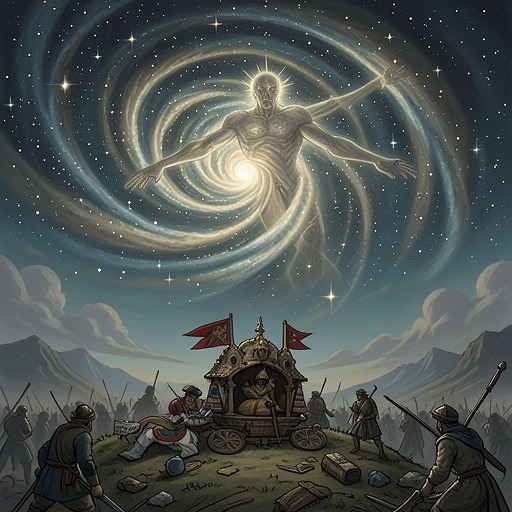
The relationship reaches its most overwhelming form when Krishna reveals his cosmic form. After Arjuna has witnessed it, Krishna resumes his ordinary form and comforts him. Arjuna says that seeing Krishna’s gentle human form has restored his right mind and normal state. Krishna then explains that the form Arjuna saw is difficult even for the gods to behold and cannot be attained through the Vedas, austerities, gifts, or sacrifices alone; exclusive devotion makes it possible to know, see, and attain him. The return to the human form is therefore not a retreat from revelation but a restoration of the form through which the friendship and instruction can continue.
Change and Narrative Significance
By the end of the dialogue, Arjuna’s position has changed from bodily collapse and refusal to a conscious acceptance of Krishna’s command. Krishna does not simply impose an order; he explains that Arjuna should reflect fully and then act as he chooses, while also warning that refusal born of self-conceit cannot finally escape the force of nature and one’s own duty. His final appeal gathers instruction and intimacy together: Arjuna is told to set his heart on Krishna, become his devotee, sacrifice to him, bow to him, and take him as his refuge. Krishna then offers the most radical form of surrender, asking Arjuna to abandon all duties in favor of Krishna as his sole refuge and promising deliverance from sin.
Arjuna’s answer confirms the transformation. He says that his delusion has been destroyed, his recollection restored through Krishna’s favor, and his doubts dispelled; he is now firm and will do Krishna’s bidding. The statement marks a decisive value shift in the relationship. The same warrior who had laid down Gandiva because kinship made action intolerable now accepts action after receiving a new account of self, duty, sacrifice, and divine order.
Sanjaya’s closing testimony gives the relationship its final narrative frame. Through Vyasa’s favor, Sanjaya has heard the supreme mystery from Krishna, the Lord of Yoga, and he repeatedly recalls both the wonderful conversation and Krishna’s extraordinary form. His conclusion joins Krishna and Arjuna as the paired source of prosperity, victory, greatness, and eternal justice: wherever Krishna is, there is the great bowman Arjuna. Their relationship therefore becomes more than a private friendship or a teacher-student exchange. It is the structural center through which the book converts a battlefield hesitation into a vision of disciplined action, devotion, and restored moral agency.